
Minutes of the MPC meeting show Das felt economy needs more monetary stimulus as inflation outlook remains uncertain.
The Reserve Bank of India on Friday decided to keep the benchmark interest rate unchanged at 4 per cent but maintained an accommodative stance as the economy is yet to recover from the impact of the second Covid wave.

The core inflation is down and there is a need to push growth.

The RBI's Review is completely at odds with its actions.
In its mid-term review of the 2006-07 monetary policy, the central bank had raised the ceiling on overseas borrowings by banks to 50 per cent of their unimpaired tier-I capital (equity, reserves plus perpetual debt) from 25 per cent.

Five of the six external members had suggested that the central bank should reduce the policy rate.

GDP growth of 7.7 per cent in the first half of this fiscal has "left sceptics gasping and woefully behind the curve", an RBI article said on Wednesday. It also stressed the buildup in the growth momentum is likely to be sustained. The article on the state of the economy published in the Reserve Bank's December Bulletin on Wednesday also said CPI-based retail inflation is expected to ease to 4.6 per cent in the first three quarters of 2024-25 from 5.6 per cent in November.

The Reserve Bank of India's rate-setting panel will go for a 0.35 per cent hike in the key repo rate at its meeting next week, an American brokerage said on Wednesday. The hike will be accompanied by a change in the policy stance to "calibrated tightening", Bofa Securities said in a report published ahead of the Monetary Policy Committee (MPC) resolution which is set to be announced on August 5. RBI has hiked the rate by a cumulative 0.90 per cent in two tightening moves in May and June, responding to the runaway headline inflation which has consistently overshot the upper end of the target set for the central bank for many months.

India is gearing up to introduce a six-member monetary policy committee that would vote on interest rates.

From the 30-share blue-chip pack, Adani Ports jumped over 5 per cent. NTPC, Tata Steel, Bajaj Finserv, Zomato, Bajaj Finance, Tata Motors, State Bank of India, IndusInd Bank and Maruti were among the other big gainers. From the 30-share pack, Hindustan Unilever, Titan, Tata Consultancy Services, Infosys and UltraTech Cement were the other laggards.

The Reserve Bank will present the mid-quarter Monetary Policy Review on Tuesday.

The Reserve Bank on Friday took steps towards normalisation of liquidity management to pre-pandemic levels, with the introduction of the standing deposit facility (SDF) as the basic tool to absorb excess liquidity, and narrowing the liquidity adjustment facility (LAF) to 0.50 per cent from the 0.90 per cent. Governor Shaktikanta Das said the SDF will be at 3.75 per cent, 0.25 per cent below the repo rate and 0.50 per cent lower than the marginal standing facility (MSF) which helps the banks with funds when required. The SDF has its origins in a 2018 amendment to the RBI Act and is an additional tool for absorbing liquidity without any collateral.

April policy could be all about RBI communication.

'Choose an FD tenure that provides a balance between returns and the horizon for which you can invest.'

The Monetary policy committe comprising 6 members voted 6-0 in the favour of the rate cut.
Three policymakers aware of the central bank's deliberations on the Budget said they are combing through the numbers to test how Jaitley struck a balance, and question some of the assumptions.
The halt in the RBI's monetary tightening drive comes after 13 hikes since March, 2010.

Reserve Bank will hold its first bi-monthly monetary policy review for 2016-17 on Tuesday.

Relations between the Mint Road and North Block have often been frosty, with the former's calls for lowering rates being the biggest point of difference

The Reserve Bank of India (RBI) on Friday kept the key repo rate unchanged at 4 per cent in view of rising inflation and faint signs of economic growth amid the gradual lifting of coronavirus related countrywide lockdown.
The 30-share Sensex ended down 113 points at 20,570 and the 50-share Nifty closed 44 points lower at 6,101.

The policy guidance marks a clear shift in RBI's monetary policy stance towards addressing growth risks while not de-emphasising the objective of containing inflation

The industry urged the central bank to consider a rate even before the next monetary policy review on July 30.

If imputed inflation for April and May is used, then you have inflation of over 6 per cent for two consecutive quarters, which is a worrying signal for the RBI.

The repo rate, at which the central bank lends to the system, will come down to 5.75 per cent after the cut.
200 staffers, consisting of RBI officials and support teams, who are essential to perform critical functions, were isolated at a separate facility in a dedicated quarantined environment near all three RBI data centres.

Raghuram Rajan on February 2 left the key interest rate unchanged.

The policy review observed that the moderation in inflation, excluding food and fuel, that was witnessed in the first quarter of 2017-18 has "by and large, reversed".

India's political infighting is denting business confidence.
The RBI in its monetary policy review in October has revised the inflation forecast to 6.5 per cent by March-end from 5 per cent earlier.

The Asian Development Bank (ADB) on Wednesday slashed India's GDP growth forecast for FY23 to 7 per cent from the earlier estimate of 7.2 per cent mainly on account of higher inflation and a tight monetary policy. India's economy grew 13.5 per cent year-on-year in the first quarter of 2022-23, reflecting strong growth in services, ADB said in its second supplement to Asian Development Outlook Report 2022 (ADO 2022). "However, GDP growth is revised down from ADO 2022's forecasts to 7 per cent for FY2022 (ending March 2023) and 7.2 per cent for FY2023 (ending March 2024) as price pressures are expected to adversely impact domestic consumption, and sluggish global demand and elevated oil prices will likely be a drag on net exports," ADB said.

In the mid-quarter review on December 18, the Reserve Bank left key policy rates unchanged but said it will hike interest rates if inflation does not subside.
The interest rates on deposits continue to be high despite ample liquidity due to monetary policy uncertainty and expectations that liquidity would tighten later this year. Banks are still offering peak interest rates of 9 to 9.5 per cent on deposits

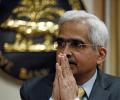
Acharya was one of the youngest deputy governors in the central bank's history and was in charge of the critical monetary policy department which also made him a part of the rate-setting panel.

As the Indian economy started getting impacted by the global financial crisis, RBI cut its short-term lending rate (repo) by 4.25 percentage points to 4.75 per cent and borrowing (reverse repo) by 2.75 percentage points to 3.25 per cent.
RBI is scheduled to announce the annual credit policy on May 3.
'A strong foreign exchange reserve is the best safety net against global spillovers.'

Reserve Bank Deputy Governor Michael Patra on Wednesday said the central bank's views about cryptocurrencies might have delayed the government's proposed legislation on crypto assets. Emphasising that the Central Bank Digital Currency (CBDC) will be introduced in FY23 as announced by Finance Minister Nirmala Sitharaman in the Budget speech, Patra said India will proceed very gradually on the subject as there are concerns on privacy, its impact on monetary policy formulation and energy intensity. The government had plans to introduce a bill on cryptocurrencies like Bitcoin during the Winter Session of Parliament in November-December 2021 but did not introduce it.
